From Parlour Performance to the Village Hall Programme
A village hall programme changes how rural performance meets its audience, from invitations and timing to attention, access and the conversation afterwards.
How does a rural performance change when it moves from a parlour into a village hall? The room changes the audience’s role as much as the seating: a private gathering can feel like a visit, while a programmed event asks people to arrive together and give the work their attention. That shift is the subject here, not a claim that one format is better.
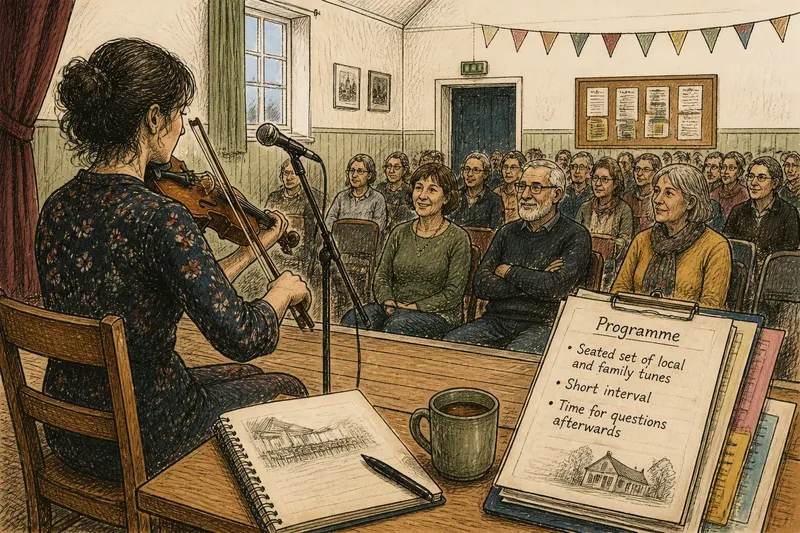
Imagine that Mara, a fictional fiddle player, has been invited to play a handful of tunes in a neighbour’s parlour. The gathering goes well, and she is asked to develop the idea into an evening on the village hall programme. Nothing about the music has to change at once. The conditions around it do: who can attend, how they know about it, what they expect to happen, and how much of the event Mara must organise.
A parlour invitation makes the audience part of the occasion
In the parlour, Mara’s audience is a group of people who already have a reason to be there. The host knows them, or knows how they are connected. An invitation may travel through a neighbour, a family message or a conversation after choir practice. The small social circle does some of the organising before the first note sounds.
That familiarity can make the performance unusually responsive. A listener may ask about a tune, remember a dance from childhood or offer a story that changes the direction of the evening. The performer can notice who is following closely and who would rather listen without speaking. There is no firm division between the person presenting and the people receiving the work, even if Mara remains the only musician.
But an invitation is also a boundary. Someone outside the host’s circle may never hear about the event; someone who does hear may wonder whether they are welcome. The parlour setting offers intimacy partly because it is selective, though that selectiveness may be unplanned. A host can make the terms clearer by saying who may come, whether guests are welcome and whether there is room for anyone who asks. That small clarity prevents the cosy atmosphere from doing the unhelpful work of an unofficial door policy.
The arrangement also carries practical obligations. The host provides a room and may take responsibility for refreshments, chairs and introductions. Mara arrives as a guest rather than as the person responsible for the whole occasion. That can leave more attention for playing, while making the event dependent on one household’s space and goodwill.
A programme changes the invitation into a public offer
In the village hall version, the event becomes one item among others. It has a title, a date, a start time and a place on a printed or online programme. People can decide to attend without knowing the performer or the host. The audience is no longer simply a group brought together by existing relationships; it is assembled by the offer of the performance.
This changes what Mara needs to communicate. “Fiddle tunes in the parlour” may be enough for people who know the host and can ask what the evening will be like. A public listing needs to explain the experience more plainly: whether the set is mostly listening, whether conversation is welcome, whether there will be a break, and whether newcomers need any prior knowledge. A precise description does not flatten the work. It gives a stranger something to decide from.
The hall also redistributes responsibility. A committee member may manage bookings, a volunteer may open the building, and someone else may introduce the performer. The division can make an event possible without asking Mara to do every task. It can also make the occasion feel impersonal if nobody takes responsibility for welcoming people once they arrive. The useful question is not whether the event has a formal organiser, but whether the audience can tell who is looking after the room.
Say Mara’s first hall listing reads only “Traditional music, Friday evening”. A prospective listener who does not know her cannot tell whether to expect a concert, a session or a dance. She revises it to say that she will play a seated set of local and family tunes, with a short interval and time for questions afterwards. The expected observable result is a clearer choice for the audience: people can decide whether that listening format suits them before they set out. The music itself has not been made more accessible by a slogan; the terms of attendance have simply become visible.
The audience relationship depends on how the evening is framed
A hall does not automatically turn listeners into a silent audience, just as a parlour does not automatically make everyone feel at ease. The format is built from small decisions that tell people what sort of participation is invited. A row of chairs facing a performer implies focused listening. Chairs in a loose semicircle leave more room for eye contact and conversation. A clear invitation to ask questions afterwards gives quieter listeners permission to wait rather than interrupt.
Mara can choose a frame without scripting every response. She might introduce each tune briefly, or leave the music to speak before explaining anything. She could invite a conversation at the end, rather than asking for comments between pieces. The important distinction is between making participation possible and requiring it. A public event should not assume that every attendee wants to perform sociability on cue.
Timing carries a similar message. A firm start helps people plan and signals that the performance has a shape. An informal welcome before the music begins gives late arrivals a chance to settle without making them the centre of attention. If the evening includes a break, the interval can be a social part of the programme rather than dead time. If there is no break, the listing should say enough for people to judge whether the format is comfortable for them.
Audience members also arrive with different expectations. Some may want to listen closely; others may hope to meet neighbours or hear familiar tunes. A short welcome can name the intended balance: perhaps this is a listening set, with conversation afterwards. That statement need not police the room. It gives the audience a shared understanding and lets Mara concentrate on the work instead of repeatedly negotiating the atmosphere.
What should the hall listing explain?
Is a village hall performance still informal?
It can be informal in tone while remaining clearly organised. A friendly host, plain language and an unforced conversation can sit alongside a published start time and a named contact.
Should Mara keep the same programme as the parlour set?
She can begin with the same tunes, then consider whether the order and introductions suit a larger, less familiar audience. The decision should follow the intended listening experience, not an assumption that a hall demands a more polished or more elaborate show.
How can newcomers tell whether they are welcome?
The listing can say that the event is open to anyone, explain how to reserve a place if needed and name whom to contact with access questions. A personal welcome at the door reinforces that information without making newcomers explain why they came.
Does a programme need audience participation?
No. Listening is a valid form of participation, and some people prefer not to speak in a group. If questions, singing or shared music are part of the evening, describe them as invitations rather than obligations.
The hall asks for a different kind of care
Once the event is public, practical details become part of the audience relationship. People need to know where to enter, whether the building is accessible to them, how to ask about seating and whether they can attend without booking. Mara and the organiser should check the hall’s own information and agree who will answer enquiries. Where a matter depends on local rules, the venue’s arrangements or a performer’s needs, confirm it directly rather than relying on a vague promise in a listing.
The welcome can be simple. A person at the entrance can point out the room, show where coats may go and identify the seating available. The introduction can tell people what will happen and when questions are welcome. These gestures do not require elaborate production. They help make the public format legible to someone who has never been to the hall for an arts event.
It is not worth spending time inventing a grand theme for an evening whose central pleasure is hearing Mara play. Nor does the hall need decorative signs for every doorway if the entrance is already obvious. Attention is better spent on information people need to make a choice and on a real person being available when they arrive. A programme can be modest without being obscure.
The change in format can be gradual
Mara need not treat the move from parlour to hall as a leap from private hobby to formal production. She can retain what worked in the first gathering: a warm introduction, a tune with a personal connection and space for conversation. She can change the parts that relied on everyone knowing one another: the invitation, the description, the arrival arrangements and the explanation of how the evening will unfold.
After the hall performance, she and the organiser can talk through what they observed without turning audience behaviour into a verdict. Did people understand the listing? Were newcomers greeted? Did questions fit better at the end than between tunes? Such questions point to choices they can revise for another event. A quiet room is not proof that the audience was disengaged, and lively conversation is not proof that every listener got what they wanted.
The village hall programme gives Mara a way to meet people beyond a host’s immediate circle, while asking her to make the invitation more explicit. The parlour offers a close, socially held encounter; the hall creates a public one whose welcome must be made visible. For rural performers considering that move, the most useful starting point is the audience relationship they want to invite. The room can support it, but the wording, timing and human welcome tell people how to take part.