A Rainy-Day Arts Walk: Read the Thresholds, Not the Distance
A rainy-day arts walk turns entrances, windows and covered pauses into a way to meet rural creative work without treating the route as a race.
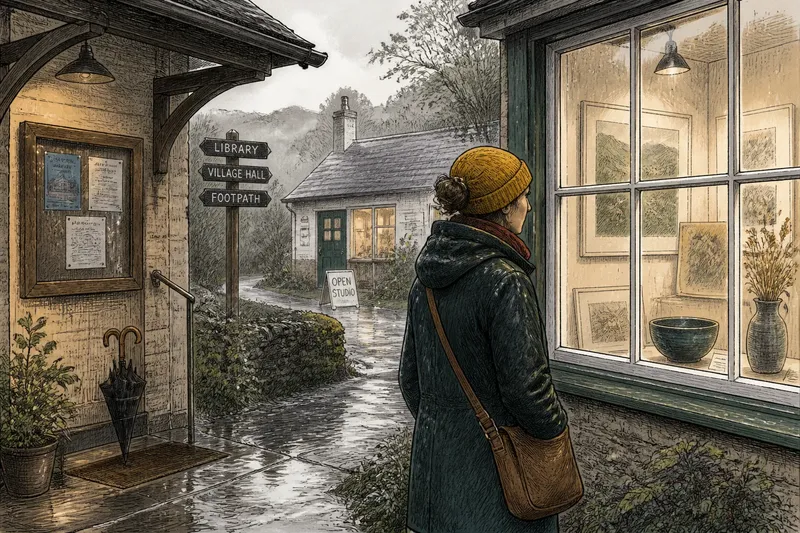
Where can you encounter rural creative work on a wet afternoon without turning the outing into a march between venues? A rainy-day arts walk is less about distance than about thresholds: the doorway where a public lane becomes a shared room, the window that lets a display meet passing weather, and the sheltered pause where you decide whether to go in.
Rather than trying to cover every stop, give the walk a modest span and let each transition do some of the work. This is a routine for one afternoon, with a little preparation beforehand and room to change course when the rain, opening arrangements or your own appetite for damp cuffs intervenes.
Choose a small circuit with useful thresholds
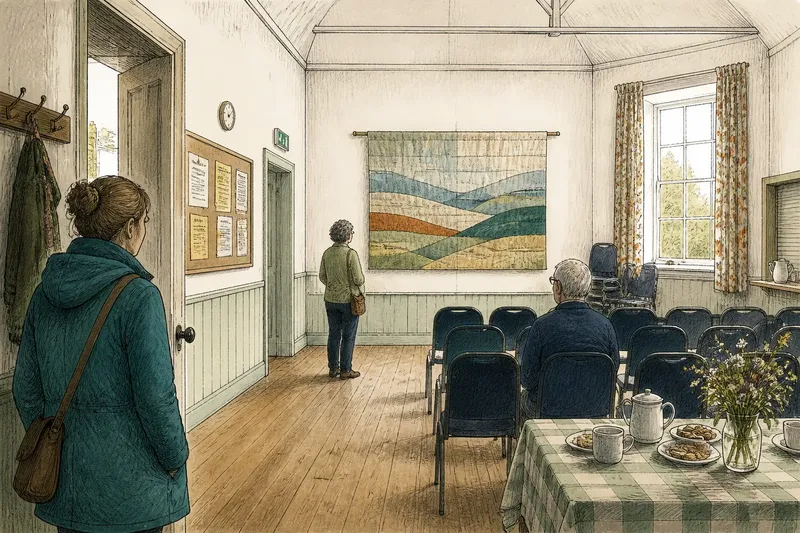
Start with places that are already part of ordinary local life: a library with a noticeboard display, a village hall hosting an open studio, a shop window with work by a nearby maker, or a community room where an exhibition can be viewed during stated opening hours. The point is not to assemble a grand itinerary. It is to find a few different ways that creative work meets people before, at and beyond an entrance.
Use a paper map, a local directory or the venue’s own information to check which places are open and whether entry is invited. Keep the route compact enough that you can reach the next stop without hurrying. If two places are far apart, treat them as separate outings rather than padding the afternoon with a long wet road.
Notice the route between stops as well. A public footpath, a shopfront and a hall entrance each establish a different kind of welcome. But do not assume that a visible door is an invitation to enter: a home studio, private yard or working building may be in view without being open to visitors.
Prepare for weather without making weather the project
Before leaving, check opening information and any local access notes. Wear a coat that can be managed indoors, shoes suited to the route, and bring a small bag for wet gloves or a folded umbrella. A notebook is useful if you want to record how an entrance or display is arranged; a phone can serve the same purpose, provided photography is allowed.
Keep your hands free where possible. A bulky umbrella is awkward at a narrow doorway, and dripping gear needs somewhere sensible to go. If a venue has a place for coats, use it; if not, keep wet items away from artwork, display materials and other visitors. These are small courtesies, not a test of outdoor competence.
Set a simple rule for changing the plan: if the route becomes unpleasant or a venue is unexpectedly closed, skip that stop and use the nearest sheltered public place for a pause. Do not try to rescue the itinerary by walking faster. Rain is already supplying enough urgency.
Read the approach before crossing the doorway
At each stop, give the outside a moment of attention. Is there a sign at eye level, a handwritten note beside the handle, or a display visible from the path? Does the entrance face the road, a courtyard or a car park? Such details shape who can recognise the place as open and what they can understand before deciding to enter.
Look for practical signals rather than guessing at intention. An open door, posted hours, a bell, a ramp or a note asking visitors to knock each suggests a different way to approach. If the information is unclear, pause and ask through the stated contact method rather than trying a side entrance. A courteous question can be more useful than a confident tug at an unfamiliar door.
Rain makes these boundaries especially legible. A porch can create a brief public pause; a mat can mark where outdoor mud should stop; a window can let a passer-by look without committing to a visit. None of these features has to be grand to affect the encounter. The threshold is part of how the work is offered, even when it is not itself an artwork.
Let windows and sheltered edges set the pace
At a window display, look from the public path first. Notice whether the work can be seen at ordinary walking height, whether reflections obscure it, and whether a short caption gives enough context to understand what is on view. Avoid pressing against glass or blocking a doorway while you look. If the display is in a shop or a working space, follow the usual rules for visitors rather than treating it as a gallery by default.
A covered step, arcade or public shelter can be a useful pause between visits. You might jot down what changed when you moved from open air to shelter: the sound of rain, the view of a noticeboard, or the way people share a narrow entrance. Keep the observation concrete. “The exhibition felt welcoming” tells you less than “the hours were readable from the lane and the door was easy to identify”.
Say you plan to visit a hall display and a maker’s window, but the hall is closed when you arrive. You could read the notice at the entrance, check the posted opening information, then continue to the window and spend the remaining time looking at how its caption and lighting work in the rain. The observable result is a shorter outing with a clear encounter, rather than a search for another door that may not be open.
Move through the afternoon in three loose phases
Use the afternoon as a sequence of decisions, not a timetable that must be completed. The following rhythm leaves room for access needs, conversation and weather without asking every stop to deliver the same kind of experience.
- Before setting out: Choose a small group of public or clearly advertised places, confirm opening information, and identify one sheltered place where you can pause. If access details are missing, contact the venue or choose a stop with clearer information.
- At the first entrance: Read the signs and observe how the building meets the public route. Enter only where the invitation is clear, and give people already using the space room to pass.
- Between stops: Use the walk to notice changes in visibility and welcome. If rain makes a path uncomfortable, take a shorter public route or leave that stop for another day.
- At the final stop: Decide whether another visit would add something distinct. If it would only repeat the same kind of encounter, finish with a sheltered pause and note the venue details you may want later.
The routine works best when each stop has a different threshold to read: perhaps a street-facing window, a public building’s foyer and a hall reached from a shared entrance. If all you find is one open place, stay with that. A single well-observed encounter is not a failed circuit.
What should you do when the invitation is unclear?
Can I look through a window without going inside?
Usually, looking from a public path is the least intrusive option, but respect signs, privacy and any request not to photograph. If the window belongs to a private home or a space with no public display information, do not linger as though entry were implied.
What if a venue is closed?
Check its posted information and use the listed contact route if you want to confirm another opening. Do not try an unmarked door or assume someone inside is available to host visitors.
How long should the walk take?
Let the weather, access and available opening hours determine the length. A compact outing with time to pause is more useful than a fixed duration that turns every entrance into a checkpoint.
Should I photograph the work or the entrance?
Ask or look for a clear photography policy before taking pictures, especially indoors. If permission is not evident, make a written note of what you noticed instead.
Leave with a useful trace, not a scorecard
Afterwards, record a few practical observations: which venues had clear hours, where a covered pause was available, and what made an entrance easy or difficult to recognise. If a detail might help the organiser, send a brief, specific message through the venue’s public contact channel. “The opening hours were hard to read from the path” is more actionable than a general verdict on whether the place felt welcoming.
There is little value in collecting every poster, photographing every window or forcing a complete circuit. Those habits can turn a rainy-day arts walk into admin with damp sleeves. Keep only the notes that may help you return, help another visitor find the public entrance, or help a local organiser make the invitation clearer.
A rainy-day arts walk can be small and still offer a distinct way to meet rural creative work. Read the threshold before crossing it, notice what the window makes visible, and let the route end when the next useful encounter has already happened. The walk is not measured by how far you go, but by how clearly each place tells you where public attention is welcome.